Why we went all in on Crew


Ten days before we were set to launch Tortuga's go-to-market bundle for AI builders, we ran our own marketing through a tool Josh had been building on the side. It told us our positioning was broken, our ICP was a fiction, and the bundle didn't make sense. We canceled the launch. Ten days later, that side project was the company.
The four products
Most of 2025, Josh and I shipped consumer iOS apps to figure out what AI building actually looked like in practice. We picked iOS because we'd both spent careers there. Josh was early at Perplexity and built primary iOS at Floor (acquired by OpenSea) and Zenrez (acquired by Square). I was founding designer at Button and Floor. We knew the medium.
After three apps, we built four tools for the people we were becoming: small teams shipping fast with AI.
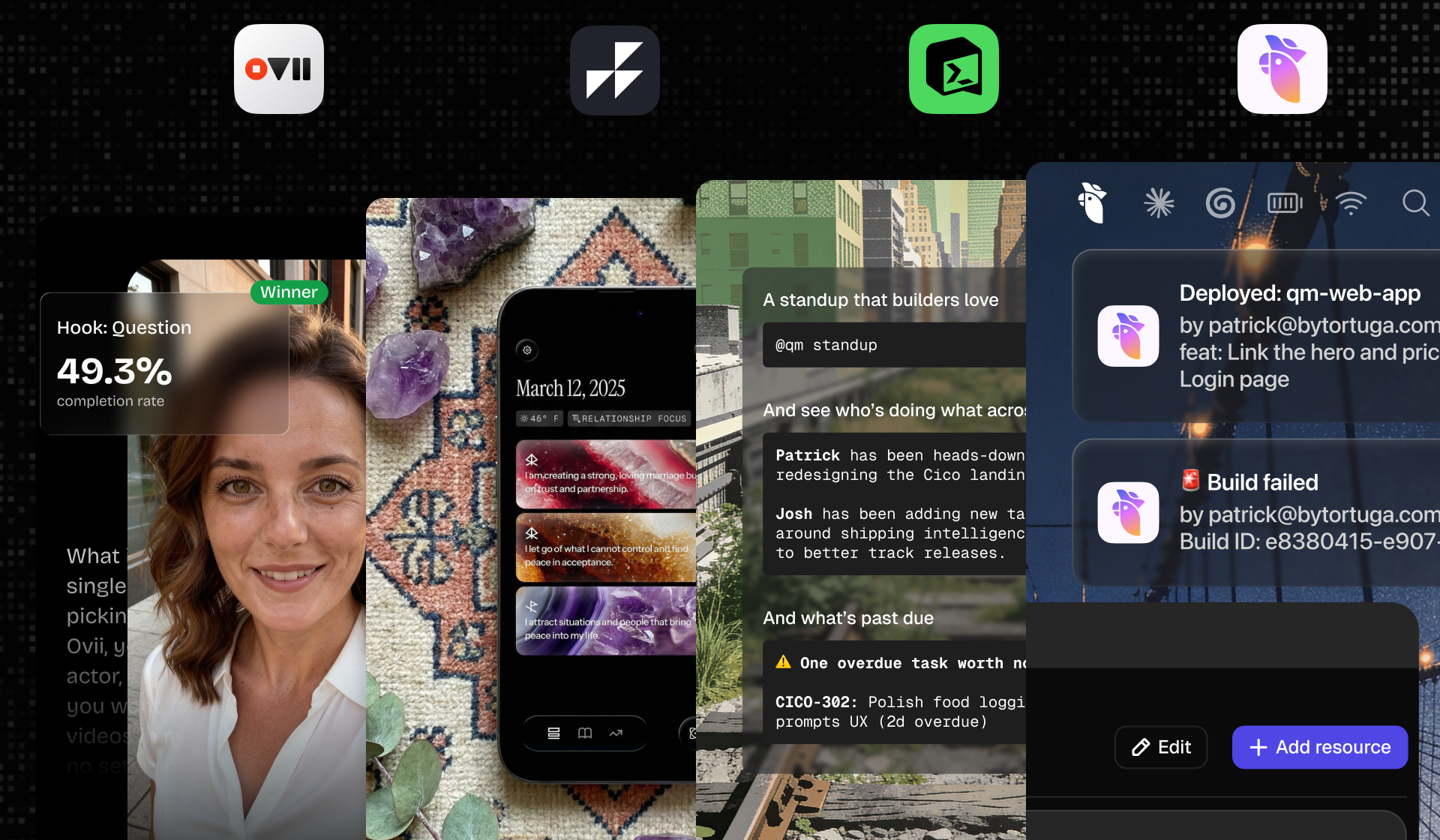
- Ovii, an AI-actor UGC video generator, because if you build it, sometimes they don't come, and you need distribution.
- Flagship, a prompt-based mockup generator, because every landing page and App Store screenshot needs decent mockups, and we'd literally seen three companies use the same Figma plugin template, two of them direct competitors.
- Quartermaster, AI-native task management inside the IDE, before Linear shipped MCP, with the stuff small teams use and none of the stuff they don't.
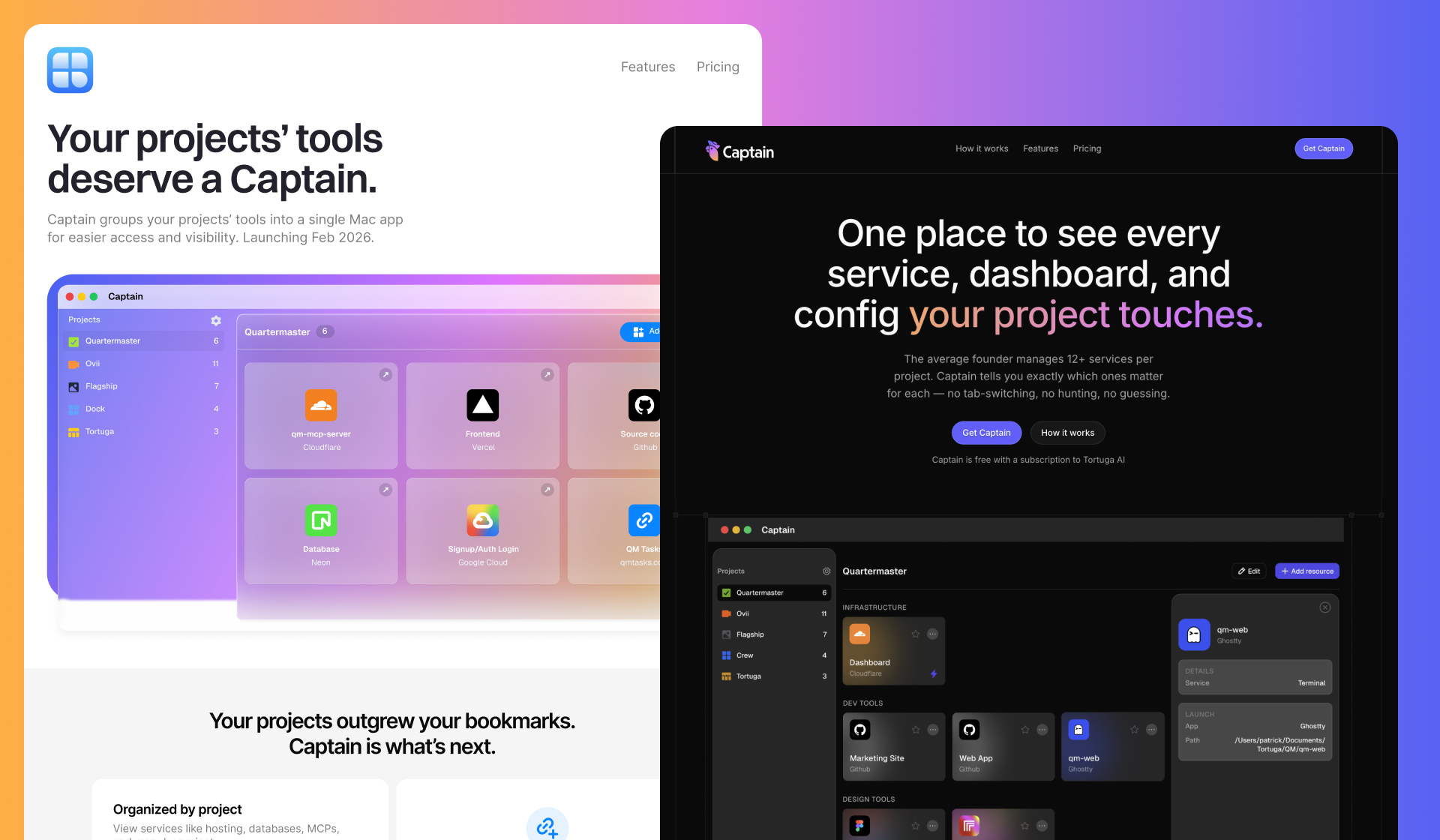
- Captain, a desktop Mac app that's a better home for your project's services than your bookmarks bar. New teammates get oriented in a minute. Some integrations go deeper, like Cloudflare deploy visibility.
We were proud of all four. We still use them. They were ready to ship as a bundle for AI builders.
The weekend that killed the bundle
Josh had been building a side tool to test our launch readiness, an evaluator that runs your marketing against AI personas of your ideal customer. We pointed it at the Tortuga bundle the weekend before launch.
The feedback was harsh, and it was right. The tool told us: you think you're selling to small teams, engineering managers at early-stage startups, vibe coders, designer-builders, and YC founders. You're selling to nobody. Those four products don't share an ICP.
That word, ICP, is doing real work in that sentence. An ICP is not a one-line description of a target customer. It's who they are, what they're trying to do, and how they decide. What's the trigger that makes them go looking for a solution today? When somebody lands on your site, they got there because something pushed them. They have one problem at the top of their list this morning. If you don't know what that trigger is, you're not selling to anyone in particular.
Each of our four products had a different trigger. Ovii's trigger is "I launched and nobody saw it." Flagship's trigger is "I'm staring at the same five mockup templates everyone else uses." Quartermaster's trigger is "Linear is overkill and my team is two people." Captain's trigger is "I can't find that one URL." Different problems, different moments, different buyers. There is no version of "AI builder bundle" that catches all of those at once.
We'd done the thing I've spent fifteen years telling other founders not to do. Spray and pray, dressed up as a bundle.
Breaking an engagement vs. getting a divorce
I told Josh on Saturday: I'm glad we know now. The next two or three months would have been wasted effort. Marketing the wrong thing to the wrong people, watching the conversion numbers come in flat, slowly figuring out why. Better to break an engagement than get a divorce.
Then I said: what if we take the next ten days and use this thing on our actual sites? Fix the copy, fix the pages, fix what we can. See what happens.
What happened in those ten days is the reason Crew exists.
The Josh moment
Josh is an excellent engineer. He doesn't have a design background. He doesn't have a marketing background. For every previous launch we've done together, I was the bottleneck on copy, on positioning, on the website itself. It wasn't a question of whether Josh could contribute. He didn't have a way in.
Around day three of those ten days, Josh started shipping landing page changes. Real ones. Sharper hero copy, restructured value props, better CTA placement. He'd run the change through the evaluator, see whether the score moved, and ship the next iteration.
That's the part that broke my brain a little. The tool gave him something he'd never had before: a feedback loop with a number on it. He didn't need my taste to be the bottleneck. He could ship a change, get a structured response from a persona that resembled our actual customer, and know whether the page got better or worse on the dimensions that mattered to that customer.
By day ten, our landing pages were meaningfully better. But the bigger thing was the way we worked. Two of us shipping marketing instead of one. Both of us building from the customer in.
That's the moment we knew. This is the company.
What Crew is
Crew is a way to get feedback from agentic versions of your ideal customer. You point it at a URL or a flow. It runs a panel of ICP personas through it and scores the experience against the criteria that ICP cares about: clarity of value prop, trust signals, pricing transparency, time to value. You see what worked, what didn't, what to change. You change it. You run it again. The score moves.
We've also added expert agents, trained on the writing, talks, and portfolios of specific people in tech. A pre-seed investor. A growth founder. A designer who's launched twenty things. They give you the kind of pointed feedback you'd get from someone whose calendar you can't get on. The expert agents are the mentor layer. The ICP agents are the customer layer. You build with both.
Why this matters now
Building got faster. You know this. Cursor, Lovable, Bolt, v0, Claude Code; somebody who had an idea last week has shipped it by Sunday. The whole stack from idea to URL collapsed into a weekend.
Validation didn't move. It's still 2015. Find some users, beg them to do an interview, pay UserTesting a few hundred dollars per session, post in a Discord and hope. Or skip it entirely, ship into a void, and call the silence "no PMF."
The cost of that gap is going to grow. Anyone with an idea can now build it. A lot of what gets built will be a solution in search of a problem. AI-generated images are slop. The expensive slop is "I built this thing and it's for absolutely no one."
Crew is our bet on closing the gap. Validate at the same speed you build.
What's next
We're running Crew on builders' sites every day. Some of those will become case studies. Some of them will become product changes. Most of them will be the thing the tool was built for: a builder gets pointed feedback from their actual customer's perspective, ships the fix, and watches conversion rates improve.
If you've got a marketing page you're not sure about, Crew is free to start. Five evaluations before you pay anything. Pricing past that is built for solo builders, not enterprises.
That's the bet. We took our own medicine, killed a launch we'd worked four months on, and pivoted to the tool that told us we should. If it works, more builders will ship things their customers wanted. If it doesn't, we'll know that too.